Operation and process boundary
Reduce the wire diameter and prepare its condition for the next process.
| Incoming material | Machine operation | Output |
|---|---|---|
| Specified rod or incoming wire | Conductor preparation | Wire at the agreed diameter and condition |
Drawing changes the wire size. It does not combine wires into a conductor or apply insulation. If suitable finished wire is purchased, first confirm whether this stage is needed.
First selection check: Incoming wire, finished diameter and conductor material
Match the drawing stage to your wire.
Start with the feedstock and required wire size. Each drawing stage has its own working range.
Rod breakdown
The initial reduction of suitable rod feedstock
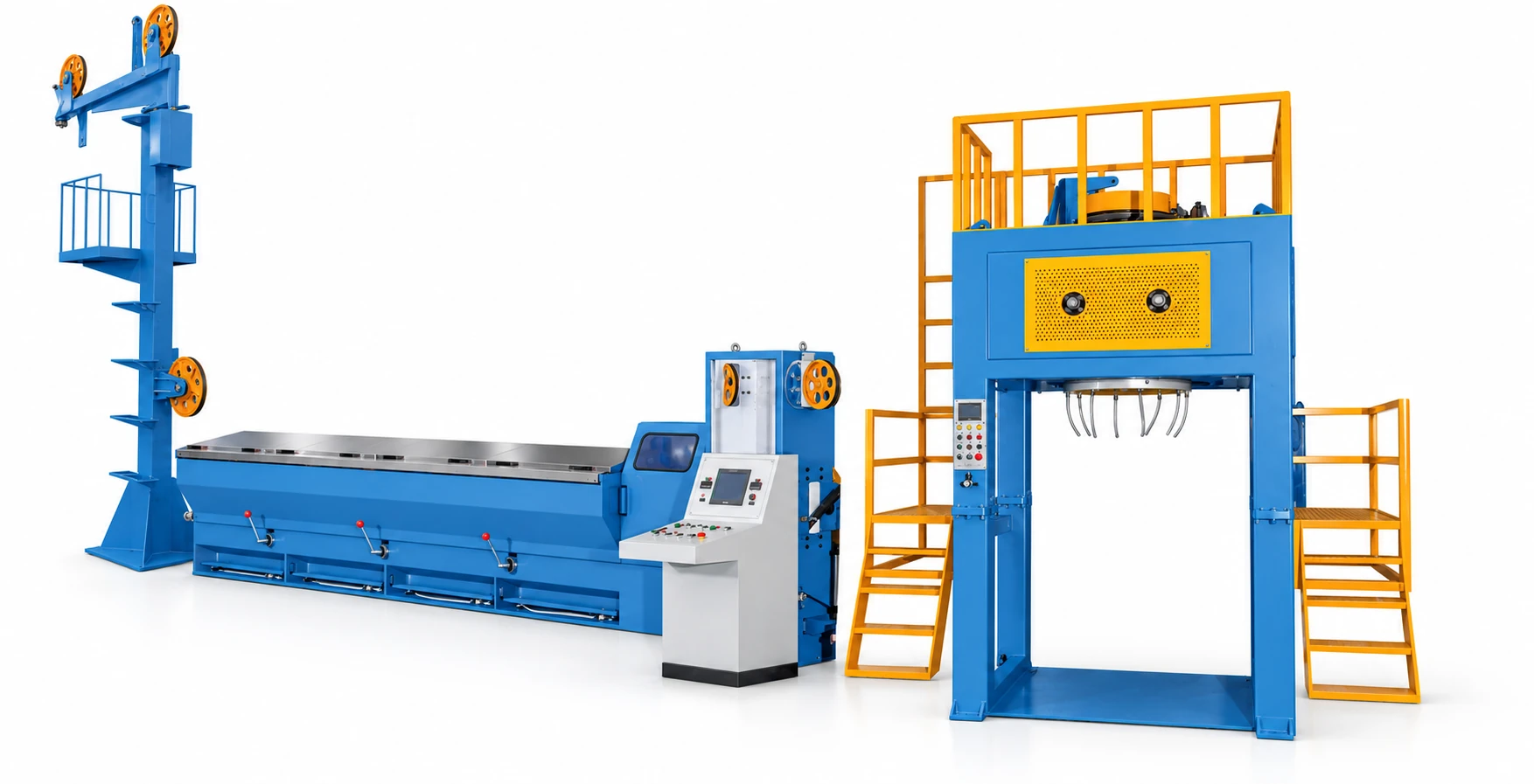
| Input | Operation | Output |
|---|---|---|
| Rod feedstock | Initial drawing | Wire for further drawing |
Review when your starting material is rod and a first reduction stage is needed.
Selection inputs: Feedstock material, input diameter and required output range.
Rod-breakdown specifications need a separate review. The ZL / ZLT table below covers intermediate drawing only.
Intermediate & medium-fine drawing
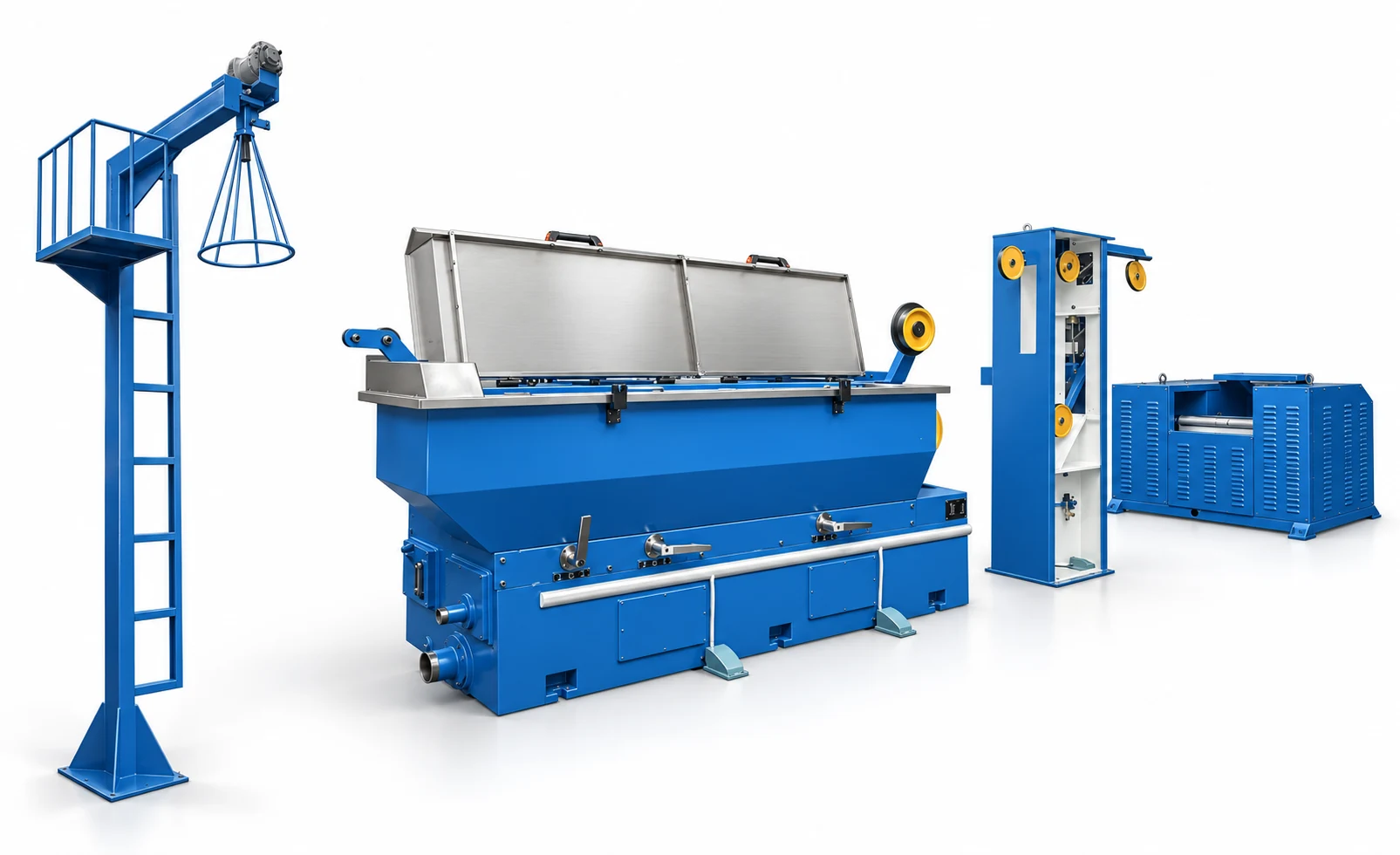
Further conductor size reduction
| Input | Operation | Output |
|---|---|---|
| Partly drawn conductor wire | Intermediate drawing | Smaller wire at the specified temper |
Review when incoming wire needs further size reduction, with or without online annealing.
Selection inputs: Input and output wire sizes, reel handling and annealing needs.
The two listed configurations cover intermediate drawing. They do not establish the range of every medium-fine machine.
Reference tables: Intermediate drawing: with or without online annealing.
Fine & micro-wire drawing
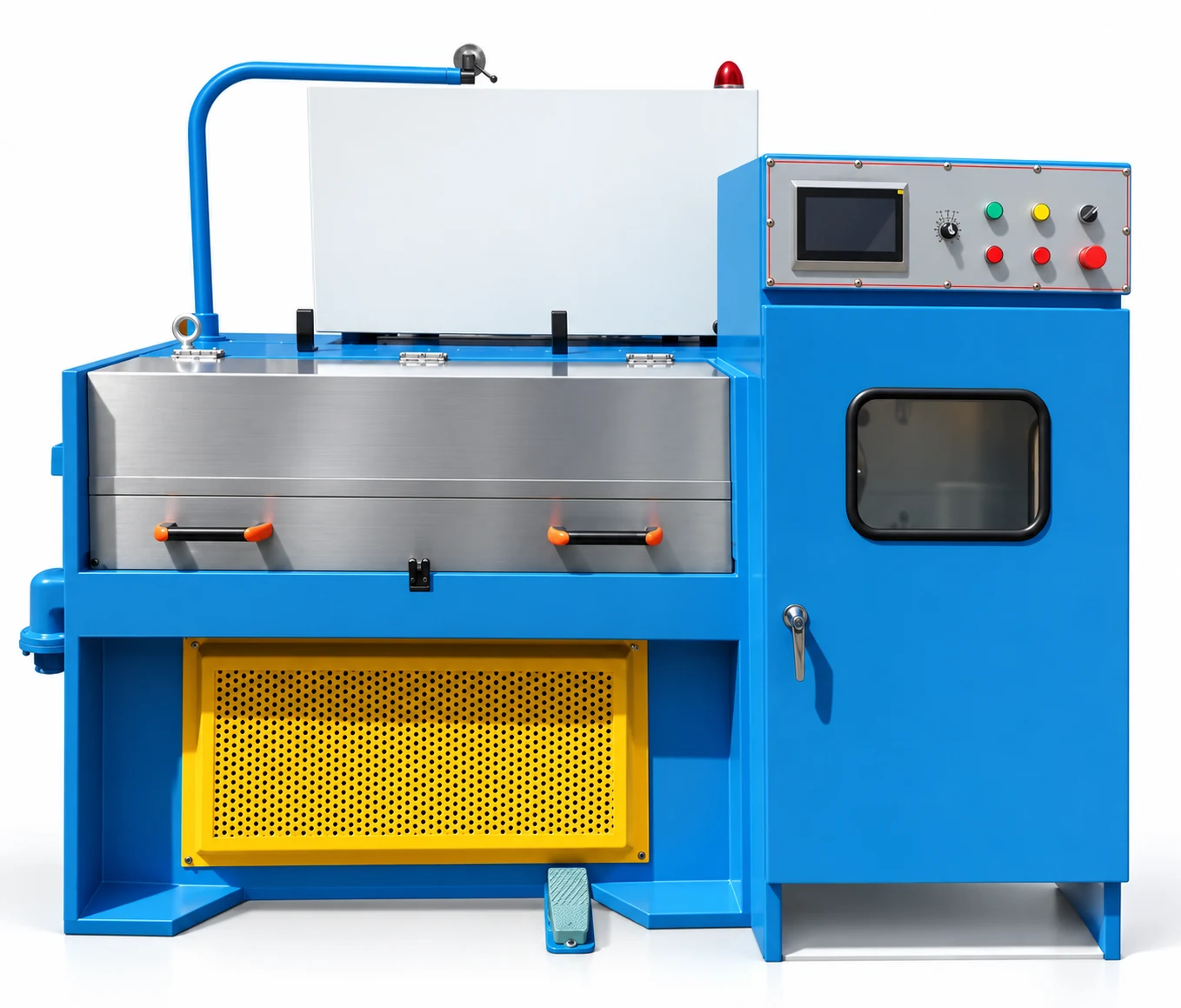
Fine conductor preparation
| Input | Operation | Output |
|---|---|---|
| Prepared conductor wire | Fine-wire drawing | Fine wire for the next operation |
Review when the required fine-wire size and handling need a dedicated drawing stage.
Selection inputs: Material, finished wire size, handling and downstream requirements.
Fine and micro-wire working ranges need their own model data; do not use the intermediate drawing limits.
Multi-wire & annealing configurations
Parallel wire processing and specified temper needs
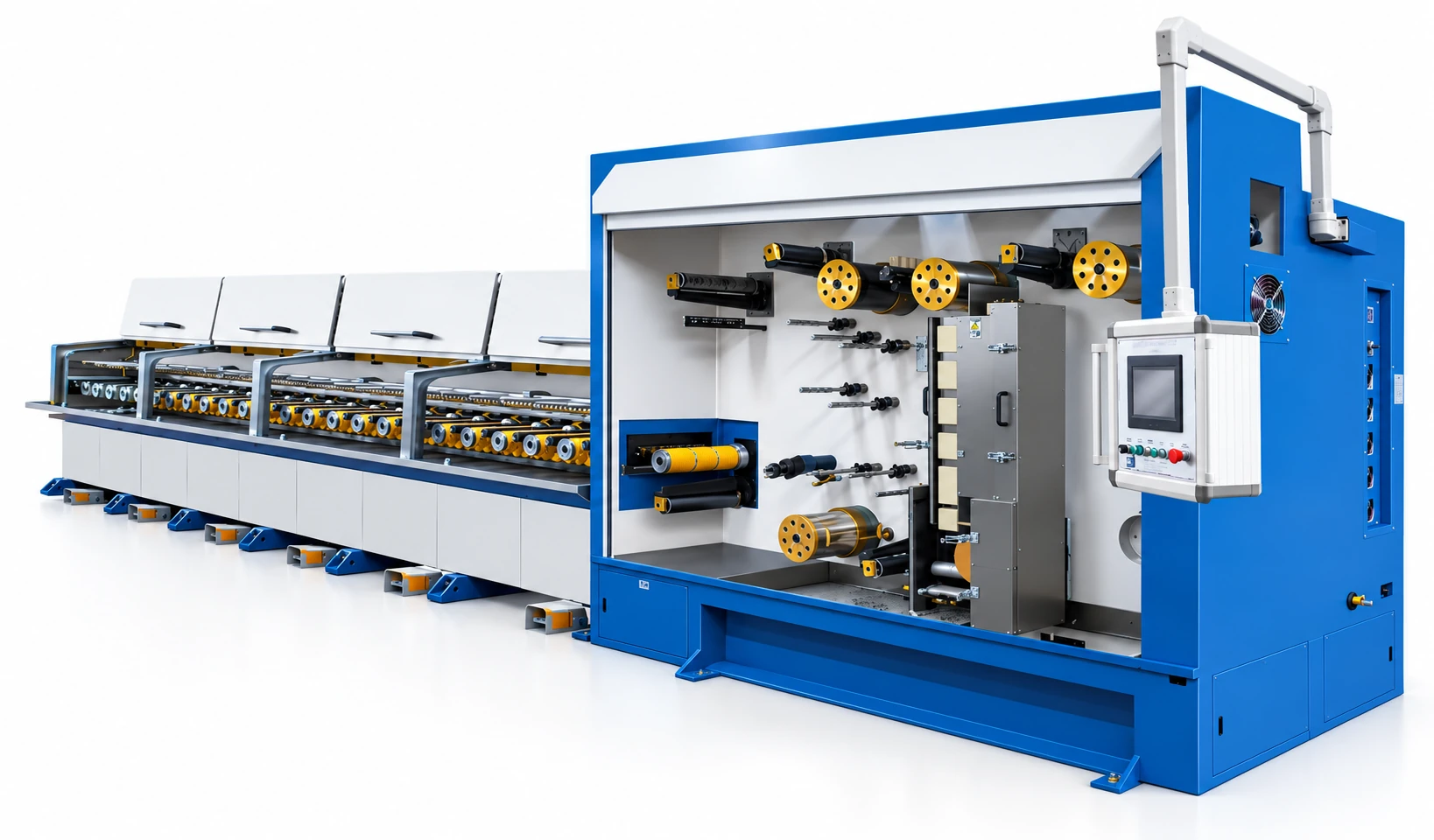
| Input | Operation | Output |
|---|---|---|
| Multiple wire feeds | Parallel drawing / annealing | Prepared wires in the required package |
Review when multiple wires share a coordinated product range and downstream reel plan.
Selection inputs: Wire count, product mix, annealing method and take-up configuration.
Confirm wire count, temper and take-up together. The intermediate drawing table does not specify this multi-wire arrangement.
Drawing range and annealing options
| Selection priority | What to review |
|---|---|
| Match the input and output | A fine-wire machine cannot replace rod breakdown. Specify both the incoming stock and the smallest finished diameter so the drawing stages can be coordinated. |
| Choose the annealing arrangement | Online annealing is a material-dependent process. The catalogue identifies copper and copper-clad copper for online annealing on the ZLT250/21; other materials need a separate review. |
| Review single-wire or multi-wire | Multi-wire drawing suits a coordinated wire range and downstream reel plan. Compare the product mix, take-up arrangement and changeovers as well as the number of drawing heads. |
Intermediate drawing: compare ZL and ZLT configurations
The table covers the listed intermediate drawing configurations only. Rod breakdown, fine and multi-wire equipment require their own working-range and reel review.
Intermediate drawing: with or without online annealing
| Model | Input Ø (mm) | Output Ø (mm) | Drawing dies | Online annealer |
|---|---|---|---|---|
| ZL250/21 | 2.6–3.0 | 0.4–1.2 | 21 | Without |
| ZLT250/21 | 2.6–3.0 | 0.4–1.2 | 21 | With |
Both catalogue configurations list Ø400 / 500 / 630 mm take-up spools. Confirm material compatibility, wire condition and the required take-up arrangement.
Configuration sequence
| Stage | What to confirm |
|---|---|
| Define the feedstock | Confirm material, rod or wire diameter and the supply format. |
| Set the output | Specify the finished wire size and the needs of the next operation. |
| Review annealing | Discuss the required wire condition and suitable annealing arrangement. |
| Match the take-up | Coordinate finished reels or coils with bunching, stranding or extrusion. |
Choose the purchase situation
Starting from rod
Your incoming material needs the first reduction stage.
Review rod breakdown against the material, incoming diameter, required output and supply format.
Provide the feedstock specification and the next drawing or stranding operation.
Making smaller conductor wire
An intermediate or fine-wire size is needed for the cable construction.
Match the drawing range and annealing arrangement to the actual input, output and required wire condition.
Provide the smallest and largest wire sizes and their downstream use.
Reviewing multi-wire processing
Several wires need to be prepared for the planned conductor process.
Compare wire count, product mix, annealing and take-up handling together; do not select from wire count alone.
Describe the product mix, finished packages and any current handling limitation.
Interfaces with the surrounding process
| Interface | Review requirement |
|---|---|
| Feedstock to drawing | Confirm material, incoming diameter, supply form and the quality information available for the rod or wire. |
| Drawing to conductor formation | Agree finished wire diameter, condition and reel format with the bunching or stranding stage. |
| Drawing to the factory | Review lubrication, cooling, utilities, reel movement and maintenance access in the proposed layout. |
Equipment package and responsibilities
Agree in the equipment package
- Drawing machine and the agreed die sequence
- Annealing arrangement for the specified conductor
- Pay-off, lubrication and cooling requirements
- Take-up reels and downstream process interfaces
Confirm separately
- Incoming rod or wire quality and material compatibility
- Utility supply, cooling equipment and consumables
- Finished wire acceptance criteria and trial material
Review the technical proposal
Can the machine make your wire, in the condition the next process needs?
| Review item | Compare on the same basis | Requested evidence |
|---|---|---|
| Working range | Confirm incoming and finished diameters together with conductor material. A smallest-wire figure alone does not define the complete reduction route. | A product-range schedule identifying the drawing and annealing arrangement for each wire. |
| Wire condition | Agree how diameter, surface condition and any required annealing result will be assessed on representative incoming material. | A trial specification and the agreed inspection method, rather than a generic running video. |
| Reel handling | Check incoming packages, finished reel dimensions and downstream pay-off compatibility. | Reel drawings, handling limits and the included take-up arrangement. |
| Consumables & utilities | Define dies, lubricant/cooling arrangements, annealing utilities and maintenance responsibilities. | A list of included tooling, buyer-supplied utilities and initial consumables. |
What changes the quotation scope?
Drawing range, wire count, annealing arrangement, dies, reel handling and lubrication/cooling equipment change the package.
Cable production applications
LAN & Data Cable
Prepare conductor wire for the specified LAN cable core.
Confirm solid or stranded conductor construction and whether prepared wire will be purchased.
LAN & Data Cable production line
Solar Cable
Prepare individual wires before the solar conductor is bunched.
Define wire size, material condition and supply reels; identify any separate material treatment.
Power & Building Cable
Reduce suitable rod or wire for the required building-wire or power-cable conductor.
Material, cross-section and strand arrangement determine the drawing stages required.
Power & Building Cable production line
USB & Data Cable
Prepare wire for the fine conductors in the data-cable drawing.
Review finished wire size, handling and the next conductor-forming operation.
USB & Data Cable production line
Coaxial Cable
Prepare the centre conductor where the project includes wire drawing.
Confirm conductor material, diameter and condition; purchased centre conductor may remove this stage.
Frequently asked questions
Is annealing always part of a drawing line?
The required wire condition and process determine whether annealing is needed and how it is arranged. The catalog includes drawing machines with online annealing configurations.
Can different conductor materials use the same machine?
Material compatibility must be checked for the selected model and process. Provide the actual material and input/output range when requesting a proposal.
How is the drawing stage connected to the rest of the factory?
Finished wire size, reel format and handling should be coordinated with bunching, stranding or the next process. These interfaces are part of the line-planning discussion.
What changes the price of a wire drawing line?
The drawing range, number of wires, annealing arrangement, take-up system and supporting utilities affect the scope. Compare quotations using the same input material, output range and supply list.
What should a production trial confirm?
Agree the trial material, input and output diameters, finished wire condition, reel format and intended downstream use before testing. Acceptance requirements should be written into the technical proposal.
Prepare the equipment requirements
| Requirement | Information to provide |
|---|---|
| Input material | Conductor material, incoming diameter and feedstock form. |
| Output wire | Required diameter range, wire condition and intended use. |
| Process configuration | Single-wire or multi-wire needs and annealing requirements. |
| Factory interface | Utilities, take-up package, material flow and available space. |
For a single machine, a line upgrade or a new production line, prepare the cable drawing, input and output requirements, reels and process interfaces.
The current project form prepares a local downloadable brief; it does not send an inquiry.