Operation and process boundary
Apply the specified insulation, dielectric or outer sheath.
| Incoming material | Machine operation | Output |
|---|---|---|
| A conductor or prepared cable core | Insulation & sheathing | An insulated core or sheathed cable |
Insulation and sheathing use different incoming products. Compound-specific curing, cross-linking, shielding and final cable testing need an explicit scope; they are not established by choosing an extruder size.
First selection check: Compound grade, input diameter, layer thickness and finished diameter
Choose the layer and material first.
Insulation coats a conductor; sheathing covers an assembled core. Match the material and dimensions before comparing extruders.
Power, building & new-energy lines
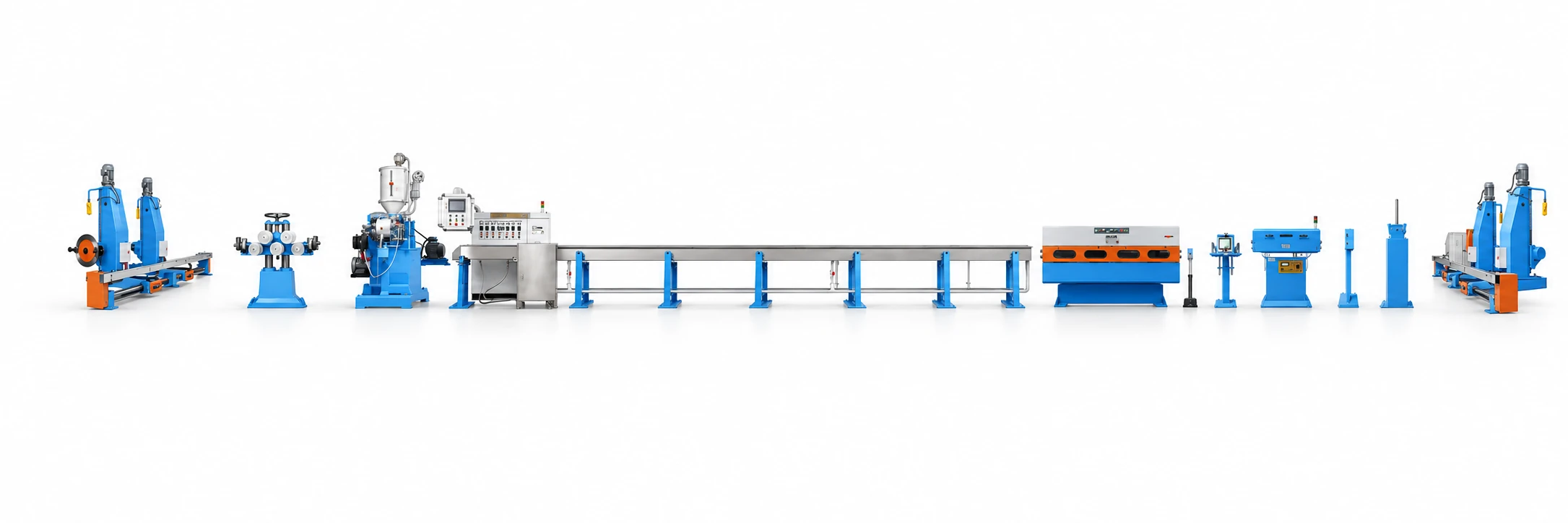
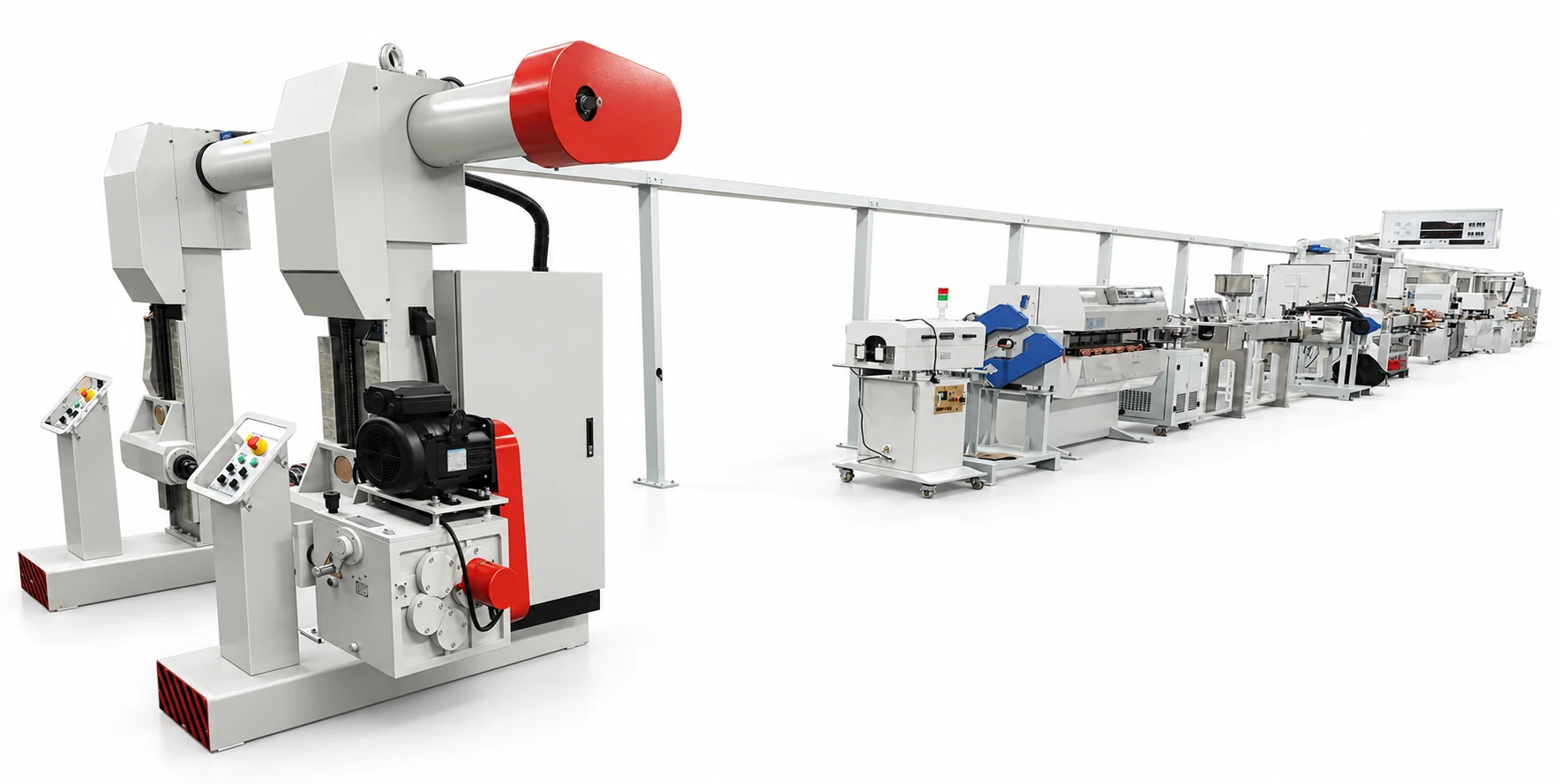
Core insulation and cable sheathing
| Input | Operation | Output |
|---|---|---|
| Conductor or assembled cable core | Insulation / sheathing extrusion | Insulated conductor or sheathed cable |
Review the required layer, compound grade and incoming dimensions. Keep these two catalogue groups separate.
Selection inputs: Material grade, conductor or core diameter, wall thickness and output.
Extrusion in kg/h is a reference machine figure, not finished-cable output. Confirm compound processing and any additional treatment.
Reference tables: Power cable insulation & sheathing; New-energy cable extrusion.
Photovoltaic cable lines
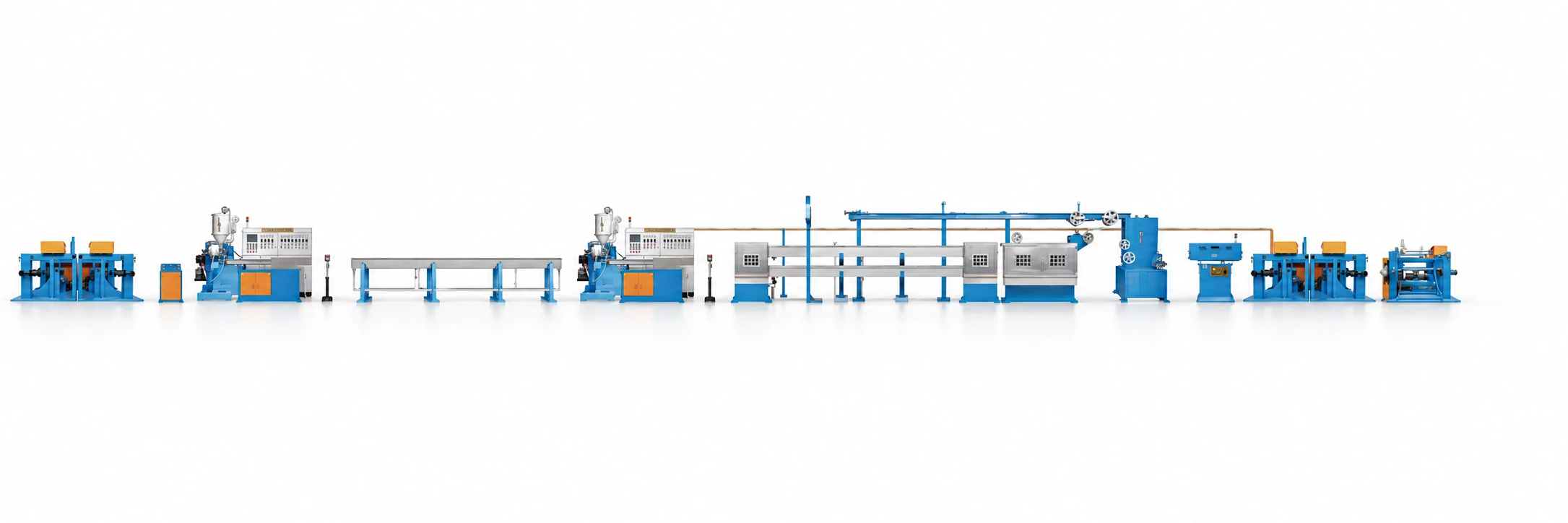
Solar cable insulation and sheath processes
| Input | Operation | Output |
|---|---|---|
| Specified solar-cable conductor or insulated core | Solar-cable layer extrusion | Insulated or sheathed solar cable |
Review the conductor construction, insulation and sheath compounds, and the required layer arrangement.
Selection inputs: Cable structure, compound specification and layer arrangement.
Confirm solar-cable specifications and material treatment separately. The power and new-energy tables are not a fixed solar-line specification.
Silicone & fluoropolymer lines
Specified specialty insulation materials
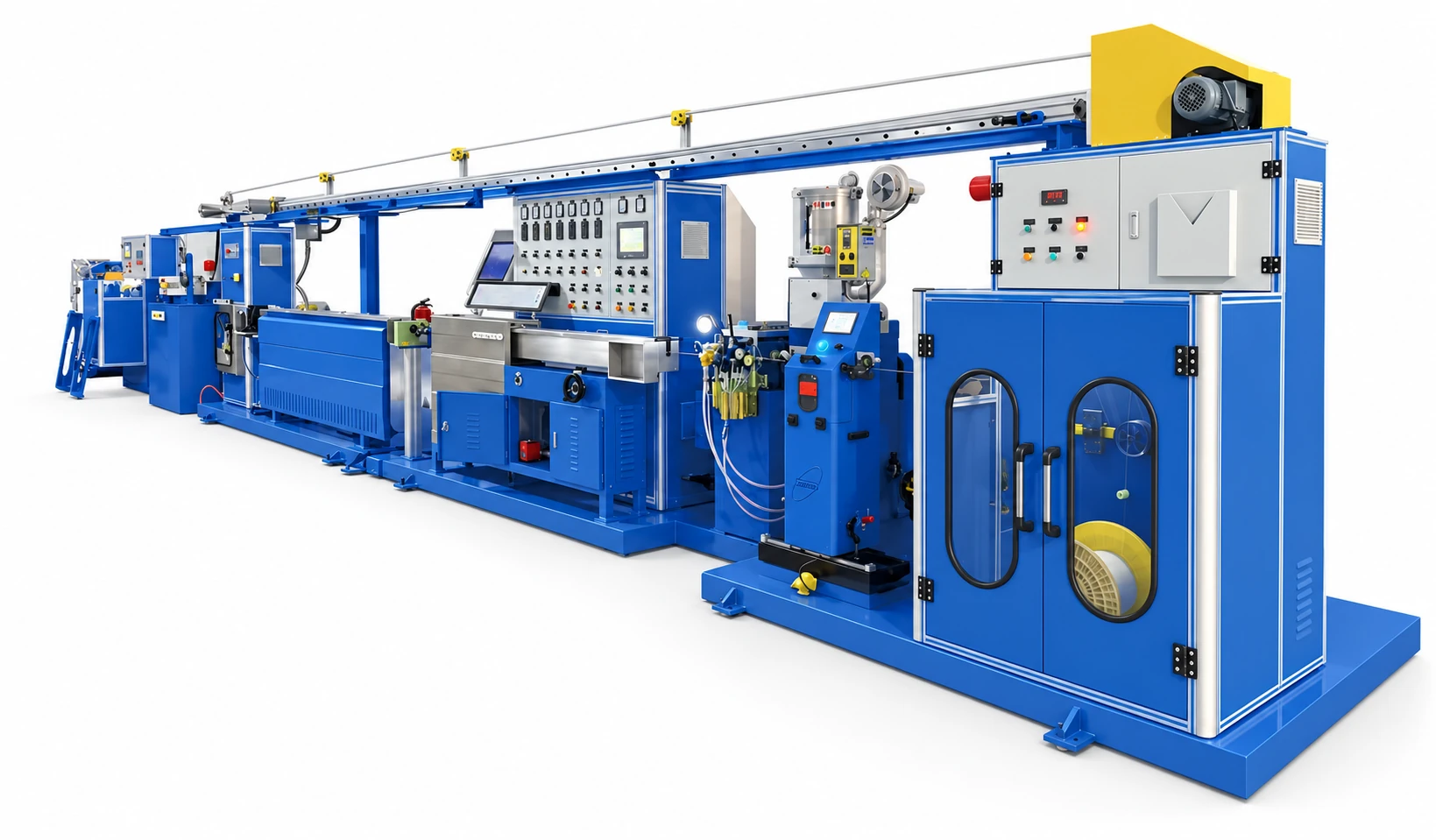
| Input | Operation | Output |
|---|---|---|
| Conductor for a specified specialty compound | Specialty insulation extrusion | Insulated wire for the specified application |
Review silicone and fluoropolymer compounds individually, including their processing and downstream requirements.
Selection inputs: Material processing requirements, wire size and associated equipment.
No silicone or fluoropolymer model table is published here. Conventional extrusion figures must not be applied to these materials.
Physical & chemical foaming lines
Foamed insulation for specified cable designs
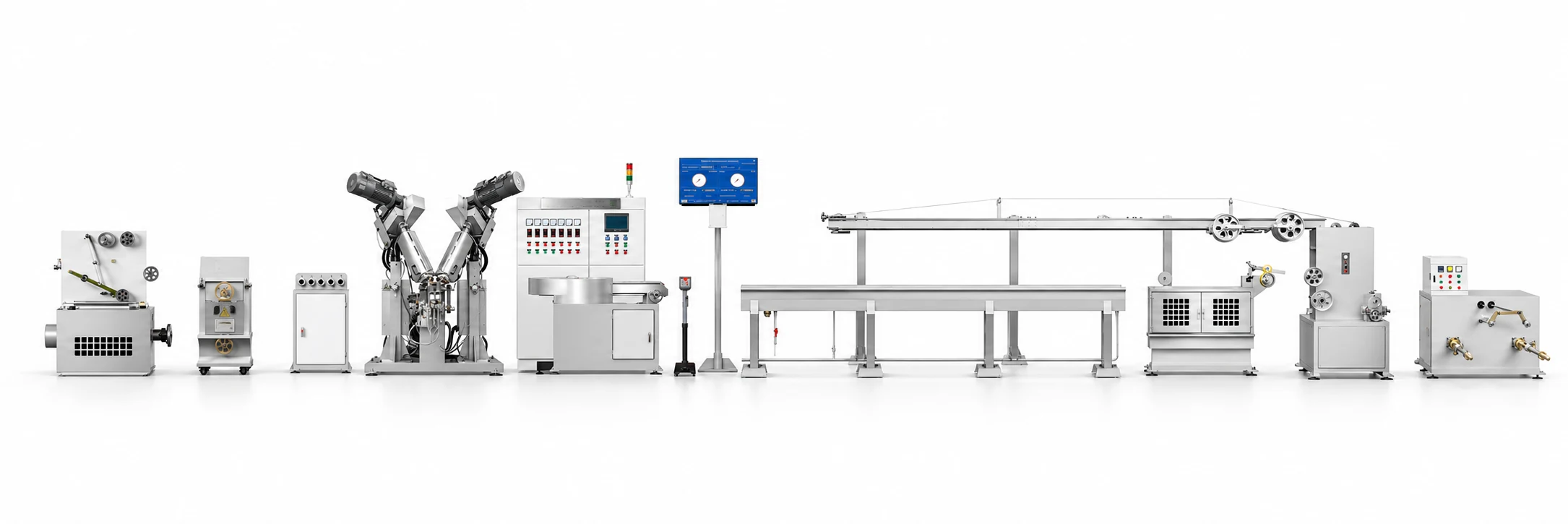
| Input | Operation | Output |
|---|---|---|
| Conductor and specified dielectric compound | Physical or chemical foaming | Foamed insulation to the cable design |
Review when the dielectric construction calls for foamed insulation; confirm the required process with the compound.
Selection inputs: Dielectric construction, material, dimensions and process requirements.
Physical and chemical foaming need their own configuration and dimensional review. The conventional extrusion tables do not establish their capability.
Compound, layer and supporting-line configuration
| Selection priority | What to review |
|---|---|
| Start with the compound | PVC, LSZH, silicone and fluoropolymers require their own processing review. Confirm the compound grade and material treatment before choosing the screw, head and downstream equipment. |
| Separate insulation and sheathing | Insulating an individual conductor and sheathing an assembled cable use different inputs. Provide the incoming diameter, layer thickness and finished diameter for each operation. |
| Balance the whole line | Extruder capacity alone does not establish finished-cable output. Review cooling, haul-off, inspection and take-up against the same cable and material specification. |
Compare extrusion configurations within the same group
Power-cable and new-energy groups are separate catalogue configurations. A shared screw diameter or model label does not make their working ranges interchangeable.
Power cable insulation & sheathing
| Model | Screw Ø (mm) | Screw L/D | Extrusion (kg/h) | Wire-size range Ø (mm) |
|---|---|---|---|---|
| PY-Φ90 | 90 | 25:1 | 300 | 5–35 |
| PY-Φ100 | 100 | 25:1 | 350 | 5–50 |
| PY-Φ120 | 120 | 25:1 | 400 | 10–80 |
| PY-Φ150 | 150 | 25:1 | 600 | 20–200 |
The catalogue lists PVC, XLPE and low-smoke halogen-free applications for this family. Compound processing and any additional treatment require confirmation.
New-energy cable extrusion
| Model | Screw Ø (mm) | Screw L/D | Extrusion (kg/h) | Conductor area (mm²) |
|---|---|---|---|---|
| PY-Φ70 | 70 | 25:1 | 100 | 1.5–10 |
| PY-Φ90 | 90 | 25:1 | 200 | 10–35 |
| PY-Φ110 | 110 | 28:1 | 300 | 35–95 |
| PY-Φ130 | 130 | 28:1 | 450 | 95–240 |
These are a separate family: the same screw diameter does not imply the same output as the power-cable line. Material and conductor construction determine the final selection.
Configuration sequence
| Stage | What to confirm |
|---|---|
| Specify the cable | Start with the input conductor or core, finished diameter and layer structure. |
| Confirm the compound | Identify the actual insulation or sheath material and its process needs. |
| Configure the line | Coordinate extrusion, cooling, haul-off, inspection and take-up equipment. |
| Plan the installation | Review the line footprint, utilities, reel handling and operating requirements. |
Choose the purchase situation
Insulating a conductor
The required layer is applied directly around an individual conductor.
Review compound grade, incoming diameter, layer thickness, finished diameter and in-line inspection.
Provide the core drawing and the smallest and largest planned conductor sizes.
Sheathing an assembled cable
A prepared cable core needs its outer jacket.
Review core dimensions, jacket compound, layer thickness, haul-off, cooling and reel handling as one line.
Provide the core and finished-cable dimensions with the required package.
Using a specialty material or dielectric
The design calls for silicone, fluoropolymer or a foamed layer.
Review the material process and layer construction before selecting the screw, head and supporting equipment.
Provide the compound specification and identify any required treatment or validation.
Interfaces with the surrounding process
| Interface | Review requirement |
|---|---|
| Incoming product to pay-off | Confirm conductor or assembled-core dimensions, reels, loading weight and tension requirements. |
| Extrusion to downstream equipment | Review the same product and output basis for cooling, haul-off, measurement, spark testing and take-up. |
| Materials to the factory | Identify feeding, drying, cooling utilities and any separate treatment required by the actual compound. |
Equipment package and responsibilities
Agree in the equipment package
- Pay-off and conductor or cable-core handling
- Extruder, screw and head for the selected material
- Cooling, haul-off and take-up arrangement
- Specified diameter measurement and spark testing
Confirm separately
- Material drying, feeding and plant cooling utilities
- Cross-linking, curing or other material-specific treatment
- Finished-cable testing and applicable product requirements
Review the technical proposal
Is the quotation based on the same compound, layer and finished cable?
| Review item | Compare on the same basis | Requested evidence |
|---|---|---|
| Material & layer | Separate insulation from sheathing. Identify the compound grade, input product, layer thickness and finished dimensions. | A cable/material schedule tied to the proposed screw, head and line arrangement. |
| Finished layer | Agree how dimensions, concentricity where relevant, surface and in-line checks will be assessed on your material. | Trial conditions, measuring/inspection scope and the acceptance points to agree. |
| Supporting line | Check pay-off, cooling, drying, haul-off, accumulation and take-up together with the extruder. | A complete equipment list and line/interface drawing with supply boundaries. |
| Output & specialist processes | Compare output on the same product. Any curing, cross-linking or other material treatment requires a separately defined scope. | Product-specific operating assumptions and a list of external processes or equipment. |
What changes the quotation scope?
Compound and layer requirements, screw/head arrangement, tooling, cooling, in-line checks, haul-off and take-up change the package.
Cable production applications
Solar Cable
Apply the specified insulation and sheath layers for solar cable.
Confirm compounds, layer arrangement and any separately required material treatment.
Power & Building Cable
Insulate conductors or sheath assembled power-cable cores.
Define each operation separately with its input diameter, compound and layer thickness.
Power & Building Cable production line
LAN & Data Cable
Apply core insulation or the finished LAN cable jacket.
The shown line is an example; confirm material and solid or foamed construction for the selected process.
LAN & Data Cable production line
USB & Data Cable
Review core insulation and jacket processes for the specified data cable.
This illustration shows a fluoropolymer line; the required equipment depends on the actual compound.
USB & Data Cable production line
Power Cord
Apply insulation to the cord conductors and a sheath where specified.
Confirm round or flat geometry and compounds. The image is a line example, not a fixed cord configuration.
Coaxial Cable
Apply the specified dielectric or the outer coaxial cable jacket.
Review solid or foamed dielectric separately; the image does not establish the final dielectric configuration.
Frequently asked questions
Can one line produce every cable material?
A line is selected for a defined material and product range. Conventional thermoplastics, silicone, fluoropolymers and foaming applications need their own technical review.
Is a published speed the output for my product?
Actual production depends on the product, compound, dimensions and complete line configuration. Confirm output against the intended cable rather than a standalone machine figure.
Can inspection equipment be included?
Spark testers and laser diameter gauges are included in the catalog’s supporting equipment. Their role and position should be agreed for the selected process.
Does a larger screw always give a better line?
No. The material, required output, cable dimensions and operating range should determine the screw and line configuration. The smallest and largest products in your planned range both need review.
What affects the price of a cable extrusion line?
The material system, screw and head, number of layers, reel handling, cooling length, controls and inspection equipment affect the quotation. Compare the complete equipment list and supply responsibilities.
Prepare the equipment requirements
| Requirement | Information to provide |
|---|---|
| Cable dimensions | Input diameter, insulation or sheath thickness and finished diameter. |
| Compound | Material type and grade, layer count and specialty processing needs. |
| Production mix | Target products, output expectations, colors and changeover needs. |
| Supporting equipment | Pay-off, cooling, haul-off, spark testing, diameter measurement and take-up. |
For a single machine, a line upgrade or a new production line, prepare the cable drawing, input and output requirements, reels and process interfaces.
The current project form prepares a local downloadable brief; it does not send an inquiry.